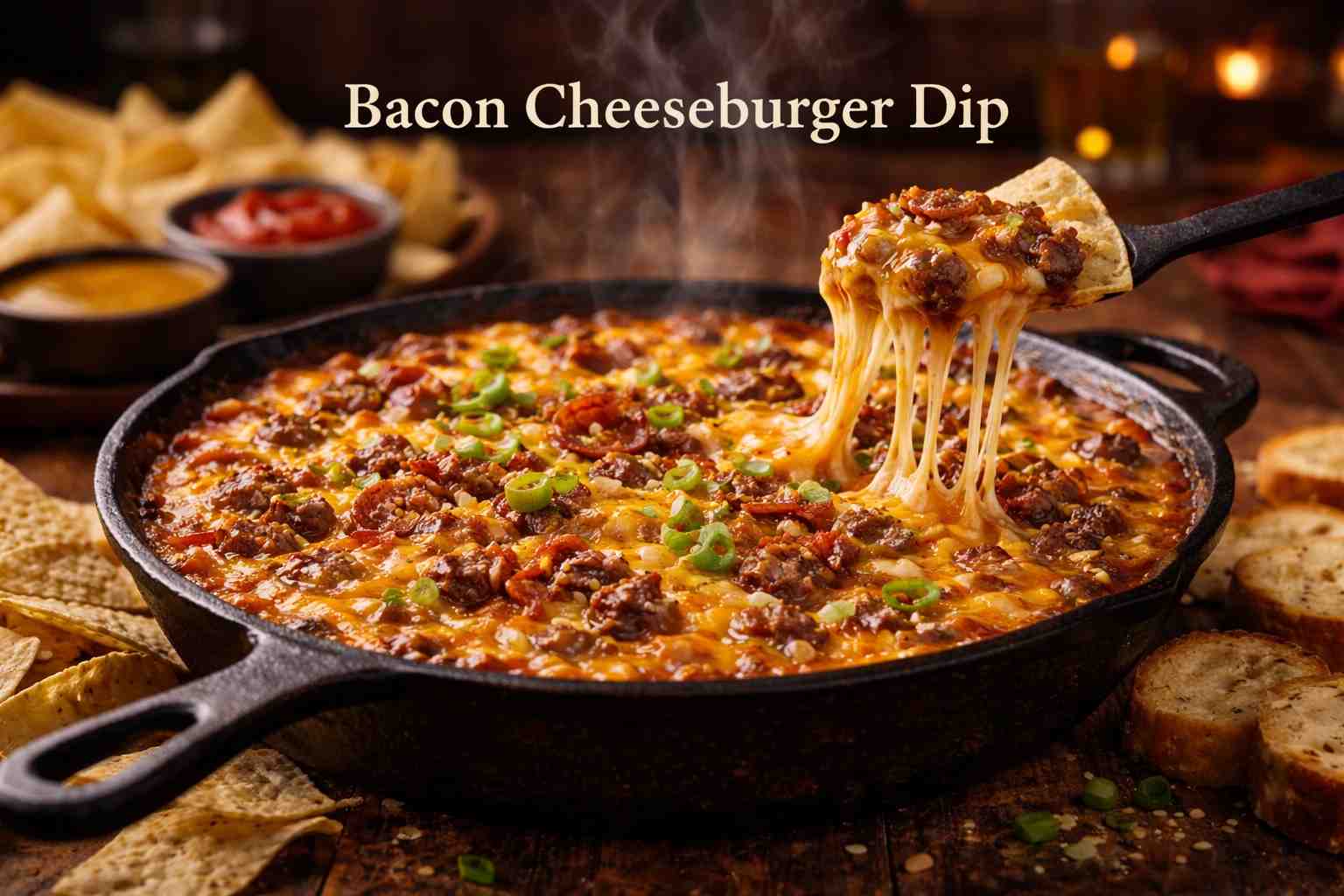
There is a particular kind of culinary genius that reveals itself not in the elaborate, the technical, or the expensive, but in the ability to take something universally beloved and present it in a form so convenient, so shareable, and so immediately appealing that the room collectively stops what it is doing the moment it arrives. The Bacon Cheeseburger Dip is exactly this kind of genius. It takes every element of the classic American backyard burger — the browned, savory beef, the crispy salty bacon, the sweet sautéed onions, the molten cheddar, the tangy condiment layer — and folds them together into a warm, bubbling, deeply satisfying dip that can be scooped with a chip, dragged through with a baguette slice, or piled onto anything with a flat surface within reach. It is the hamburger, liberated from its bun and reinvented as a communal experience.
What makes this recipe so enduringly popular — beyond the simple fact that it tastes extraordinary — is its fundamental accessibility. It requires no special technique, no obscure ingredient, no equipment that any standard kitchen does not already contain. What it requires is a pound of ground beef, half a package of bacon, an onion, a trio of dairy ingredients, two kinds of cheese, and the classic condiment combination that every American over the age of six associates instinctively with “burger flavor.” These are pantry-friendly, budget-respectful, universally available ingredients. And from them, with nothing more than a skillet, a mixing bowl, a baking dish, and twenty-five minutes of your time, you produce something that belongs on any party table in the country, at any occasion, in any season.
The dip works because it is honest. It does not attempt to be refined or subtle. It announces itself through the aroma of bacon frying and onions sautéing in bacon grease, and it delivers on that announcement with every molten, cheese-pulling, beef-laden scoop. It is the kind of food that makes people abandon their drinks to hover near the serving dish, chip in hand, conducting the kind of continuous, unconscious eating that only the most genuinely compulsive party foods can produce. Make it once and you will understand immediately why it has become a fixture of American entertaining. Make it twice and it will become yours permanently.
Recipe Specifications
| Detail | Info |
|---|---|
| Cuisine | American |
| Course | Appetizer / Snack |
| Difficulty | Easy |
| Servings | 10–12 People |
| Prep Time | 15 Minutes |
| Cook Time | 20 Minutes |
| Calories per Serving | Approx. 340 kcal |
Ingredients
The Protein Base:
- 1 lb ground beef (80/20 chuck recommended)
- 6–8 slices bacon, chopped into small pieces
- 1 small yellow onion, finely diced
- 2 cloves garlic, minced
The Creamy Base:
- 8 oz cream cheese, fully softened to room temperature
- ½ cup sour cream
- ¼ cup mayonnaise
The Cheese:
- 1 cup sharp cheddar cheese, freshly hand-grated
- 1 cup Monterey Jack (or mozzarella), freshly hand-grated
The Flavor Layer:
- 2 tbsp ketchup
- 1 tbsp Worcestershire sauce
- Salt and freshly ground black pepper, to taste
Serving Suggestions:
- Thick-cut tortilla chips or kettle chips
- Toasted baguette slices
- Dill pickle slices (for the authentic burger experience)
- Celery sticks (for a lower-carb option)
Step-by-Step Instructions
Step 1 — Preheat and Prep
Preheat your oven to 350°F (175°C) and allow it to reach full temperature before the dip goes in. Prepare your baking dish — a medium glass or ceramic baking dish (approximately 8×8 or 9×9 inch) is ideal, as glass retains heat efficiently and will keep the dip warm on the table for longer than a metal pan. Soften the cream cheese fully by leaving it at room temperature for at least 30 minutes before beginning — cold cream cheese does not incorporate smoothly into the other dairy ingredients, leaving lumps in the finished dip that compromise both texture and the uniformity of each scoop. This is a step that costs nothing but the time it takes to remember to do it, and it makes a visible and meaningful difference in the final result.
Step 2 — Cook the Bacon
Place the chopped bacon pieces in a large skillet or wide pan over medium heat. Cook, stirring occasionally, until the bacon is deeply golden, fully rendered, and satisfyingly crispy — do not rush this step or pull the bacon early. Undercooked, soft bacon loses its crispness immediately upon contact with the warm, moisture-rich dip mixture and contributes nothing of textural value to the finished dish. Fully crispy bacon, by contrast, retains enough structural resilience to provide occasional moments of crunchy contrast even after folding into the mixture and baking. When the bacon is done, remove it with a slotted spoon and place it on a paper towel-lined plate to drain and cool. Do not discard the rendered bacon fat in the pan — this smoky, pork-infused fat is one of the recipe’s most flavorful ingredients and will be used in the next step.
Step 3 — Brown the Ground Beef
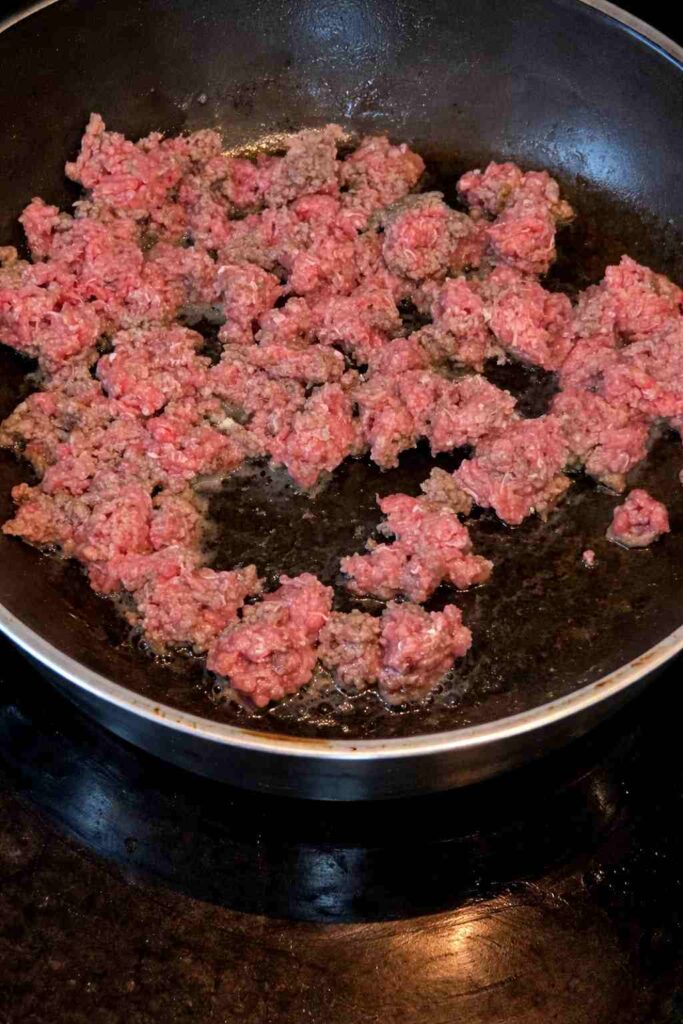
In the same pan (after removing the bacon and retaining a tablespoon or so of the rendered fat), add the ground beef over medium-high heat. Break the beef into small, even crumbles as it cooks, pressing and stirring to ensure every piece develops direct pan contact. Season with salt and black pepper during the cooking. Cook until the beef is completely browned with no pink remaining and some pieces have developed a noticeably darker, more caramelized exterior — this surface browning, driven by the Maillard reaction between the beef’s proteins and its residual sugars, is responsible for the deep, savory complexity that distinguishes properly browned beef from merely cooked beef. Once fully browned, drain the beef thoroughly through a fine-mesh strainer or by tilting the pan and spooning off the excess fat. Excess beef fat left in the mix is the primary cause of the greasy, oil-pooling finish that characterizes poorly made versions of this dip — draining properly is non-negotiable.
Step 4 — Sauté the Onions and Garlic
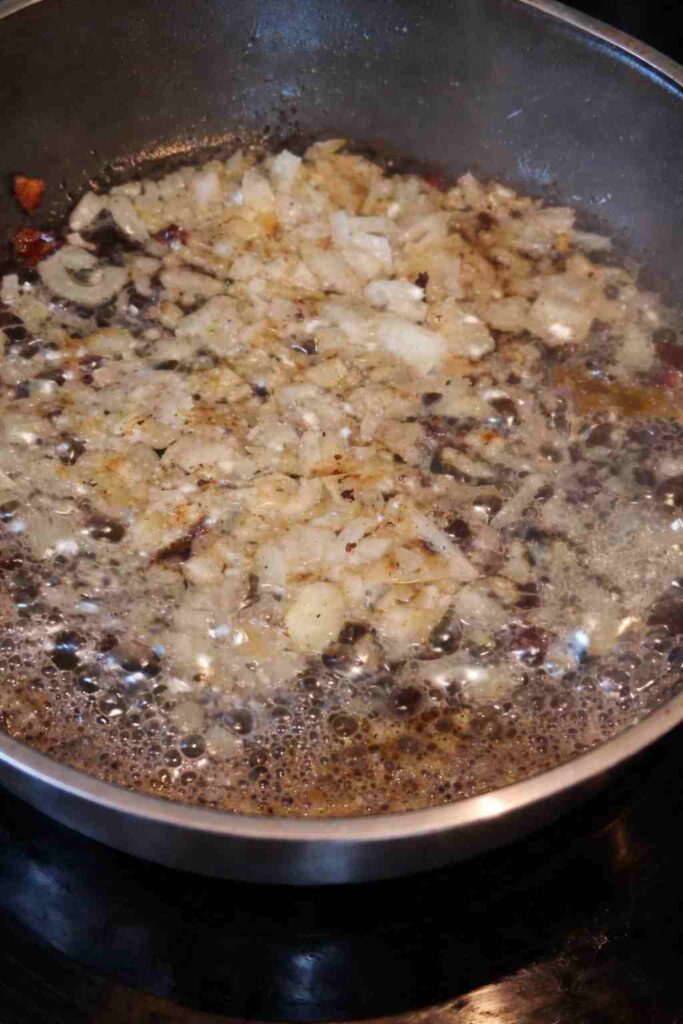
Return the pan to medium heat. Add the diced onion to the residual bacon fat remaining in the pan, stirring to coat. Cook for 6 to 8 minutes, stirring regularly, until the onion is fully translucent, soft, and just beginning to show golden color at its edges. The bacon fat in which these onions are cooking is not a neutral medium — it is actively infusing the onion with its rendered pork flavor compounds, smoky notes, and Maillard-developed aromatic richness at every moment of contact. An onion sautéed in plain oil and an onion sautéed in bacon fat are functionally different ingredients by the time they reach the mixing bowl, and this step is the recipe’s most important flavor layering moment. In the final 60 to 90 seconds of the onion’s cooking time, add the minced garlic to the pan and stir continuously until fragrant. Garlic added at this late stage loses its raw harshness without developing the bitterness of overcooked garlic, integrating into the onion base as a savory, aromatic undertone.
Step 5 — Combine the Base
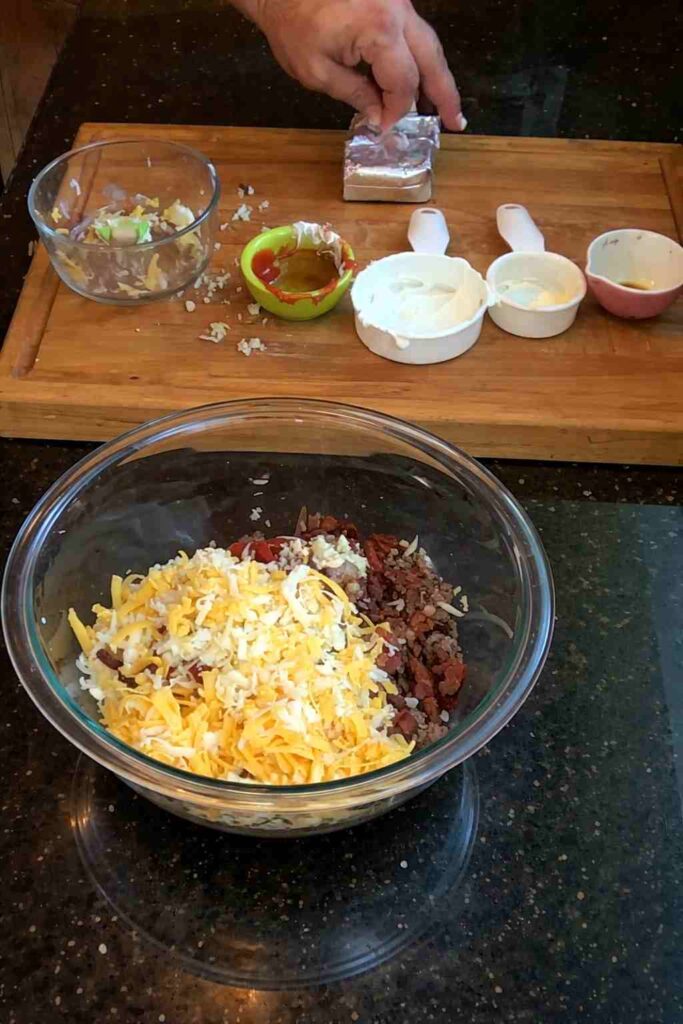
In a large mixing bowl, combine the drained ground beef, the crispy bacon (reserve a small handful for garnishing the top if desired), and the sautéed onion-garlic mixture. Stir to combine these three components evenly. Add the room-temperature cream cheese, sour cream, and mayonnaise to the bowl. Fold these dairy components into the beef mixture thoroughly, using a sturdy spatula or wooden spoon, until the cream cheese has fully incorporated with no visible white lumps remaining and the mixture has taken on a uniform, creamy-yet-chunky consistency. The three dairy components each serve a specific and non-redundant function: the cream cheese provides structure and body that prevents the dip from being thin and flowing; the sour cream provides a pleasant tanginess and a softer, more scoopable final texture; and the mayonnaise provides the specific emulsified oil-and-egg richness that contributes the unmistakable “burger sauce” quality to the dip’s overall flavor.
Step 6 — Add the Flavor and Cheese
Stir in the ketchup and Worcestershire sauce, folding them through the mixture until evenly distributed. These two condiments are the recipe’s most conceptually interesting components — together, they recreate the flavor signature of a burger in a way that is immediately recognizable to every person who has ever eaten a classic American cheeseburger. The ketchup contributes tomato sweetness, vinegar acidity, and the specific sugar balance that is one of the most deeply conditioned flavor memories in American food culture. The Worcestershire sauce contributes a concentrated umami depth from its fermented anchovy, tamarind, and molasses components — a complex, savory backbone that deepens the beef’s own savoriness and cuts through the richness of the dairy base with its gentle acidity. Fold in the hand-grated cheddar and Monterey Jack, distributing them evenly through the mixture. The dual-cheese strategy here is deliberate: the sharp cheddar provides flavor — its aged, tangy, assertive character cutting through the heavy fat content of the surrounding ingredients — while the Monterey Jack provides a superior melt quality and the elastic, stretchy “cheese pull” behavior that makes each scoop visually dramatic and texturally satisfying.
Step 7 — Bake Until Bubbling and Golden
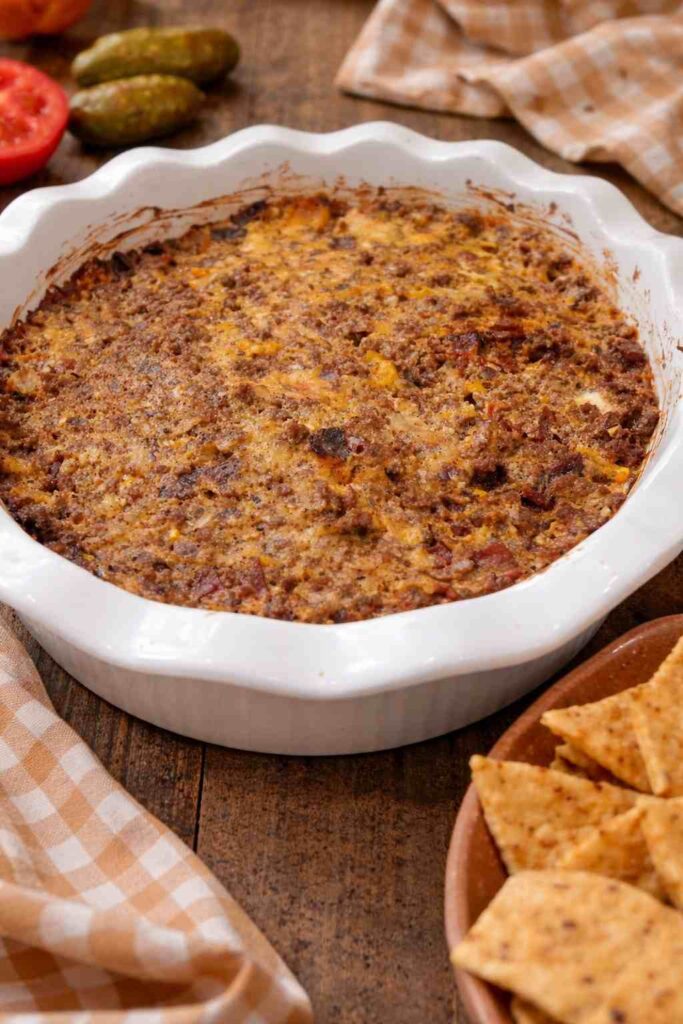
Transfer the complete mixture to the prepared baking dish, spreading it into an even layer. Place in the preheated 350°F oven and bake for 15 to 20 minutes. At the 15-minute mark, the dip should be actively bubbling around the edges — an indicator that the dairy components’ moisture has reached boiling point and that the dish has achieved the target serving temperature throughout. The surface should show golden browning in places, particularly around the edges where the cheese is in direct contact with the hot dish walls, and the cheese on top should have melted into a continuous, glossy, slightly bubbly layer. Do not overbake beyond the point of active bubbling and surface browning — extended baking causes the fat components of the dairy base to separate from the protein and starch matrix, producing the greasy, broken-looking surface that indicates an overcooked dip.
Step 8 — Rest Briefly and Serve
Remove the dip from the oven and allow it to rest for exactly 4 to 5 minutes before serving. This brief rest period allows the melted cheese surface to firm very slightly from its molten state, which counterintuitively makes the dip more scoopable — at peak molten temperature, the cheese is too fluid to cling to a chip cleanly and will flow off before it reaches the guest’s mouth. At the slightly cooled temperature after 5 minutes of rest, the cheese has regained just enough structure to coat and cling to the scooping vehicle while still flowing and stretching satisfyingly. Serve directly in the baking dish with a generous array of thick-cut tortilla chips, kettle chips, or toasted baguette slices arranged around it. For the authentic cheeseburger experience, provide a small dish of dill pickle slices alongside — the cold, briny, acidic crunch of a dill pickle against the warm, rich, cheesy dip is one of the most perfectly conceived flavor contrasts in all of American party food.
Loaded Cheeseburger Dip
Creamy, cheesy beef-and-bacon dip with classic burger-sauce flavor — baked until bubbling
- 1 lb ground beef (80/20 chuck recommended)
- 6–8 slices bacon, chopped
- 1 small yellow onion, finely diced
- 2 cloves garlic, minced
- 8 oz cream cheese, fully softened
- ½ cup sour cream
- ¼ cup mayonnaise
- 1 cup sharp cheddar, freshly grated
- 1 cup Monterey Jack (or mozzarella), freshly grated
- 2 tbsp ketchup
- 1 tbsp Worcestershire sauce
- Salt + black pepper, to taste
- Thick tortilla chips or kettle chips
- Toasted baguette slices
- Dill pickle slices
- Celery sticks
Preheat & Prep
Heat oven to 350°F (175°C). Grease an 8×8 or 9×9 dish. Ensure cream cheese is fully softened.
Cook the Bacon
Crisp chopped bacon over medium heat. Remove to paper towels. Keep ~1 tbsp rendered fat in the pan.
Brown the Beef
Brown beef in the same pan, breaking into crumbles; season with salt + pepper. Drain thoroughly to prevent greasiness.
Sauté Onion & Garlic
Sauté onion in residual bacon fat 6–8 minutes until soft. Add garlic for the last 60–90 seconds.
Combine the Base
Mix drained beef + bacon + onion/garlic. Fold in cream cheese, sour cream, and mayo until smooth (no lumps).
Add Flavor & Cheese
Stir in ketchup + Worcestershire. Fold in cheddar + Monterey Jack until evenly distributed.
Bake
Spread in dish and bake 15–20 minutes until bubbling at edges and lightly golden on top. Don’t overbake.
Rest & Serve
Rest 4–5 minutes for best scoopability, then serve with chips, baguette, pickles, or celery.
Conclusion: Why This Dip Wins Every Time
The Bacon Cheeseburger Dip wins at every occasion it attends because it operates on the most fundamental level of crowd-pleasing food psychology: it delivers exactly what it promises, without ambiguity, without pretension, and without disappointment. Every scoop contains all five of the flavor dimensions it advertises — smoky, savory, cheesy, tangy, and rich — in a ratio that is immediately satisfying to the widest possible range of palates. There is no learning curve to eating it, no acquired taste required, no moment of assessment before approval. The flavor recognition is instant, because the flavor is fundamentally that of a cheeseburger, and few things in the American food experience are more deeply and broadly beloved than a cheeseburger.
The recipe’s technique intelligence deserves acknowledgment. Cooking the bacon separately to full crispness before folding it into the moist mixture ensures it retains textural contribution rather than simply melting into the surrounding dairy. Sautéing the onions specifically in bacon fat rather than neutral oil is a flavor multiplication step that costs nothing and transforms the onion from a background aromatic into a primary flavor contributor. Hand-grating the cheese rather than using pre-shredded removes the anti-caking cellulose coating that prevents pre-shredded cheese from melting smoothly and cleanly. And the dual-dairy structure of cream cheese plus sour cream provides both body and tangy creaminess in a combination that neither ingredient could provide alone. Each of these decisions reflects real culinary thinking embedded in what appears to be a simple recipe.
At approximately 340 calories per serving across 10 to 12 portions, this dip is openly and cheerfully a treat — a high-energy, high-reward party food that makes no nutritional apologies for what it is. It stores well for 3 to 4 days in the refrigerator, reheats beautifully in a 300°F oven, and accepts customization readily: jalapeños for heat, diced tomatoes and green onions for freshness, a teaspoon of yellow mustard for additional burger authenticity, a splash of lager for pub-style depth. But it needs none of these additions to succeed. On its own, exactly as written, it is already everything a party dip should be: warm, deeply flavored, irresistibly scoopable, and completely impossible to stop eating.
FAQs about Bacon Cheeseburger Dip Recipe
What is the specific Maillard chemistry that occurs on the beef’s surface during browning and what flavor compounds does it produce?
When the beef’s surface temperature rises above approximately 280°F (138°C) in the low-moisture environment of a hot pan, the free amino acids released from the beef’s muscle proteins react with the reducing sugars (glucose and ribose) present in the beef’s cellular fluid through the Maillard pathway. The hundreds of reaction products include: pyrazines (nutty, roasted), furans (caramel-adjacent), thiophenes (savory, meat-like), and thiazoles (roasted, meaty) — together producing the complex, deeply savory, unmistakably “browned beef” flavor that distinguishes properly seared ground beef from steamed or poached ground beef. This Maillard character is the single most important flavor element in the dip’s overall profile, which is why crowding the pan (which drops temperature below the Maillard threshold) is the most common preparation mistake.
What is the technical difference between sour cream’s and mayonnaise’s contributions to the dip’s flavor and texture?
Despite both being creamy, tangy dairy-adjacent condiments, sour cream and mayonnaise accomplish completely different things in this recipe. Sour cream (typically 20% fat, pH approximately 4.5) provides its tang from lactic acid produced by bacterial fermentation of cream — a specific, clean, dairy-cultured sourness that references yogurt and contributes to the dip’s characteristic “burger sauce” tanginess. Its relatively lower fat content makes it the primary contributor to scoopable, flowing texture rather than structure. Mayonnaise (approximately 70–80% fat as an oil-in-water emulsion stabilized by egg yolk lecithin) provides dense, neutral-fat richness with a mild vinegar tang — it is the fat carrier responsible for the dip’s coating mouthfeel. Together, they produce a dairy base that is simultaneously tangy, rich, smooth, and structured in a way neither could achieve independently.
What is the specific role of bacon grease as a sautéing medium for the onions and how does it differ functionally from olive oil or butter?
Bacon grease is rendered pork fat that retains, dissolved in its fat phase, the water-soluble and fat-soluble flavor compounds produced during the bacon’s Maillard browning — including the specific smoky phenolics (guaiacol, syringol) and pork-derived aromatic esters that define bacon’s distinctive flavor. When onions are cooked in this fat, these dissolved flavor compounds transfer directly to the onion’s surfaces and, through heat-driven absorption, into the onion’s cellular interior. The resulting onion carries bacon flavor throughout its structure rather than merely being adjacent to bacon pieces in the final mixture. Neither olive oil (which contains no bacon-derived compounds) nor butter (which contains dairy compounds rather than pork compounds) can replicate this direct flavor transfer.
What specific protein chemistry explains why the dip should rest 4–5 minutes before serving?
Immediately out of the 350°F oven, the dip’s cheese components are fully molten — the casein protein network has fully denatured and the fat phase is completely liquid. At this maximum temperature state, the molten cheese has very low viscosity: it flows immediately upon any disturbance and will not cling to a chip surface with sufficient adhesion for a clean scoop. During the 4–5 minute rest, the casein networks begin partially re-forming as the temperature drops — the proteins do not return to their original solid structure (which would require refrigerator temperatures) but establish a partial, loose network that significantly increases the cheese’s viscosity. At this partially cooled state, the cheese is viscous enough to coat and cling to a chip’s surface while still being fluid enough to flow and stretch — the optimal consistency window for scooping.
Explore our extensive collection of culinary delights that range from quick weeknight dinners to impressive entertaining dishes. Start your morning right with our five essential egg breakfast ideas, or try our chili crisp egg avocado toast for a modern twist. For those seeking healthier morning options, discover our healthy oatmeal apple banana cake, coconut cove baked oatmeal, and blueberry apple morning oats cake. Vegetarian breakfast enthusiasts will love our protein powder cinnamon rolls. For lunch, enjoy classics like the ultimate big mac salad, crispy potato tacos, quick ham and cheese pinwheels, and vegan bulgogi pinwheels. Our main course selection includes impressive options such as Vietnamese lemongrass chicken, honey balsamic pomegranate glazed chicken, mushroom stuffed chicken breast, and baked French onion chicken. Meat lovers should try our three Italian style meatloaves, pan seared pork tenderloin in creamy peppercorn gravy, and citrus glazed roasted pork ribs with creamy mushroom potatoes. For pasta and seafood, explore shrimp aglio e olio, New England creamy clam chowder, Manhattan clam chowder soup, red pesto gnocchi, brown butter and sage mezzi rigatoni, and creamy peri peri chicken pasta. Our soup collection features creamy broccoli and garlic soup, carnival squash soup with turmeric, split pea soup, ham bean soup, hearty vegetable barley soup, and creamy asparagus soup. Vegetarian options include vegan ramen, quick vegan lasagna, vegan cabbage rolls, spicy maple tofu rice bowl, and vegan chicken and dumpling soup. For sides, enjoy garlic butter cheese bombs, oven baked potatoes with meatballs and cheese, broccoli recipes that taste amazing, oven roasted crispy potato, honey butter cornbread, and one pan Tuscan orzo with chicken. Our appetizer selection includes the ultimate crispy buffalo chicken wonton cups, the ultimate buffalo chicken cauliflower dip, the ultimate buffalo chicken garlic bread, and garlic parmesan wings. Desserts range from blueberry tiramisu and heavenly molten mini chocolate lava cakes to thin and chewy chocolate chip cookies. For special occasions, try red velvet cookies, Valentine heart cookies, ombre heart buttercream cake, and homemade Valentine’s day mini cake delight. Keto dieters will appreciate our keto schnitzel, sugar free keto German chocolate cake, keto yogurt almond cake, keto beef roulades, fluffy keto cloud bread, keto muffins, Korean marinated eggs, and low carb cottage cheese ice cream. Additional healthy options include sugar free oat cakes, sugar free banana oat brownies, and low carb Tuscan chicken bake. For beverage enthusiasts, enjoy our cocktail collection including classic whiskey sour, hot apple whisky lime cocktail, easy margarita, Paloma tequila cocktail, vodka cranberry cocktail, Angel Face cocktail, Mandarin Sunrise cocktail, Aperol Spritz, homemade Piña Colada, virgin Piña Colada mocktail, Moscow Mule, Old Fashioned, Manhattan cocktail, Pomegranate Gimlet, Southside gin cocktail, Paper Plane cocktail, Mango Chilli Margarita, and our ten best rum cocktails. These carefully curated recipes offer something for every palate, occasion, and dietary preference.