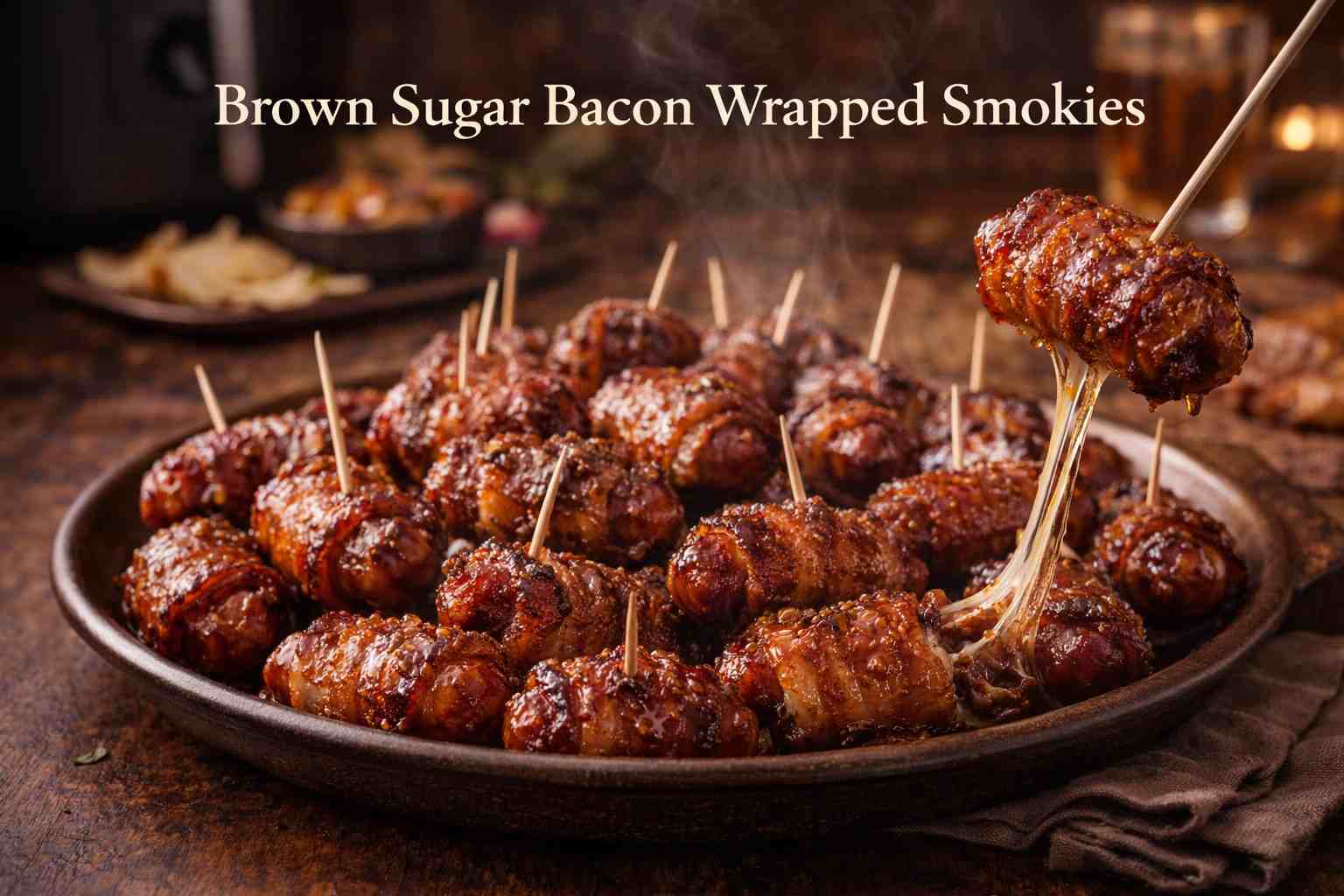
There is a category of party food that transcends taste, transcends occasion, and transcends demographic — food that disappears from the serving platter before the host has had a chance to set it down, food that generates an audible reaction from the room the moment it arrives, food that people genuinely cannot stop eating regardless of how many they have already had. Brown Sugar Bacon Wrapped Cocktail Smokies belong to this rare and magical category, and they have been doing so, consistently and reliably, at game day spreads, holiday gatherings, family potlucks, and office parties across America for decades. There is a reason they have endured.
The formula is deceptively simple: a small, juicy, pre-smoked cocktail sausage, wrapped tightly in a half-strip of bacon that has been pressed generously into brown sugar on both sides, secured with a toothpick, and cooked until the bacon is crisp and the sugar has transformed into a dark, brittle, caramelized glaze that shatters satisfyingly on first bite. Sweet, salty, smoky, and savory — all four of the most universally beloved flavor dimensions, present in a single bite-sized morsel that takes less than ten minutes to assemble and twelve minutes to cook. This is not accidental. This is the product of decades of accumulated party-cooking wisdom distilled into its most efficient and irresistible form.
What separates this particular version from the traditional oven-baked approach is the use of the air fryer — and the difference is not merely one of speed, though the time savings are significant. The air fryer’s rapidly circulating hot air creates a cooking environment that simultaneously renders the bacon fat, crisps the bacon exterior, and caramelizes the brown sugar in a fraction of the time it would take a conventional oven, without the sticky sheet pan disaster that the oven method invariably produces. The result is a crispier, more evenly glazed, more consistently executed smoky every single time — in under twenty minutes from first ingredient to first bite. Whether you are feeding a crowd of forty or a household of four, this recipe is the one you will return to every single time the occasion calls for something that is guaranteed to impress.
Recipe Overview
| Detail | Info |
|---|---|
| Cuisine | American |
| Course | Appetizer / Snack |
| Difficulty | Easy |
| Servings | 6–8 People |
| Prep Time | 8 Minutes |
| Cook Time | 12 Minutes |
| Calories per Serving | Approx. 280 kcal (based on 4–5 smokies per serving) |
Ingredients
- 1 package cocktail smokies (approx. 12–14 oz)
- 1 lb standard-cut bacon (not thick-cut)
- ⅔ cup brown sugar (light or dark — see Q&A for the distinction)
- Optional: ¼ tsp cayenne pepper or chili powder (for a sweet and spicy variation)
Equipment needed: Toothpicks and an air fryer
Step-by-Step Instructions
Step 1 — Cut the Bacon
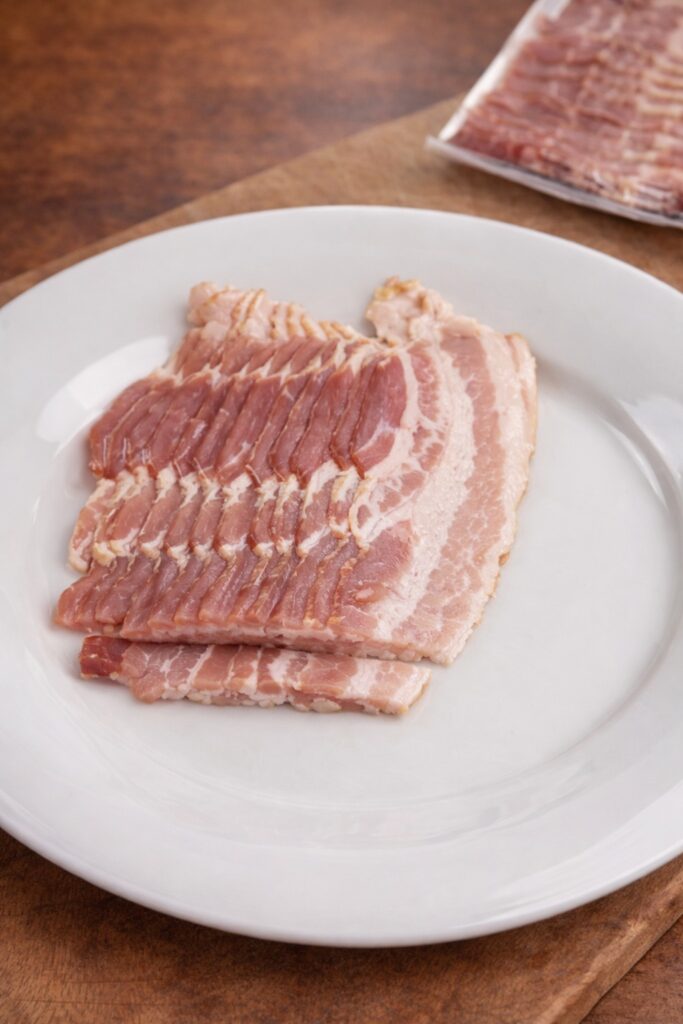
Remove the bacon from the package and cut every strip in half crosswise, producing two shorter half-strips from each full strip. This step is not merely a size adjustment — it is a technical requirement for the recipe to work correctly. A full-length bacon strip wrapped around a cocktail smoky will overlap itself multiple times, creating thick layers of bacon that cannot render and crisp in the 12-minute cook window. The outer layers will begin to caramelize and harden while the inner layers remain raw, undercooked, and unpleasantly chewy. A half-strip, by contrast, wraps around the smoky in approximately 1 to 1.5 rotations — the ideal coverage that allows every layer of bacon to be fully exposed to the circulating heat while still completely encasing the sausage. Cold bacon is significantly easier to handle, cut, and wrap than room-temperature bacon, so work directly from the refrigerator.
Step 2 — Coat the Bacon in Brown Sugar
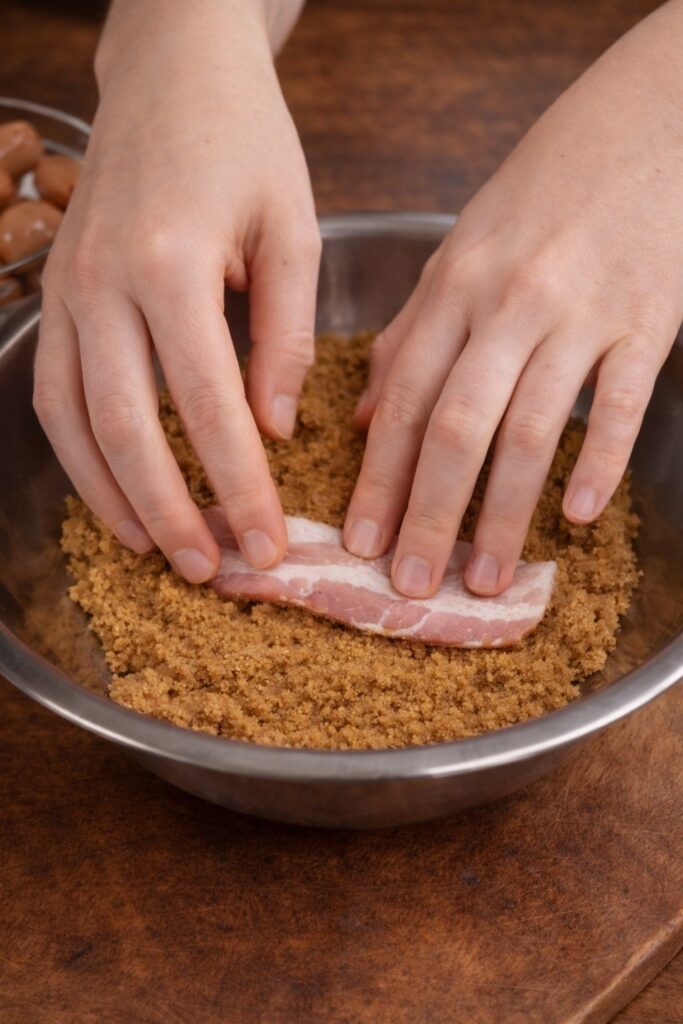
Pour the ⅔ cup of brown sugar into a shallow bowl or onto a flat plate — a wide, low-sided vessel that allows you to lay the bacon strip flat and press it down into the sugar with even, consistent pressure. Take each half-strip of bacon and lay it flat in the sugar. Press down firmly with your fingertips across the entire surface of the strip, ensuring the sugar granules are physically pressed into the bacon’s fat and protein surface rather than simply resting on top of it. Flip the strip and repeat on the other side. This pressing step is not cosmetic — the mechanical pressure embeds the sugar granules into the bacon’s slightly tacky raw surface, where the molasses in the brown sugar acts as a natural adhesive to keep them in place during handling and wrapping. If you are making the sweet-and-spicy variation, mix the cayenne or chili powder directly into the brown sugar in the bowl before beginning this step.
Step 3 — Wrap and Secure the Smokies
Place one cocktail smoky at the short end of a sugar-coated bacon half-strip. Roll the smoky forward along the bacon, wrapping the bacon tightly around it in a single smooth motion. The strip should wrap around the smoky approximately once to once-and-a-half times, with the bacon end resting against the bacon body rather than against bare sausage. Holding the wrap firmly closed, push a toothpick through the center of the overlapping bacon layers and through the sausage beneath — the toothpick should penetrate both the top and bottom bacon layers to hold the wrap securely in place. This securing step is critical: as bacon cooks, it contracts and shrinks as its moisture evaporates and its fat renders, and an unsecured wrap will open and peel away from the sausage before the caramelization process has had time to effectively “glue” the bacon and sugar together. Repeat for all remaining smokies.
Step 4 — Load the Air Fryer
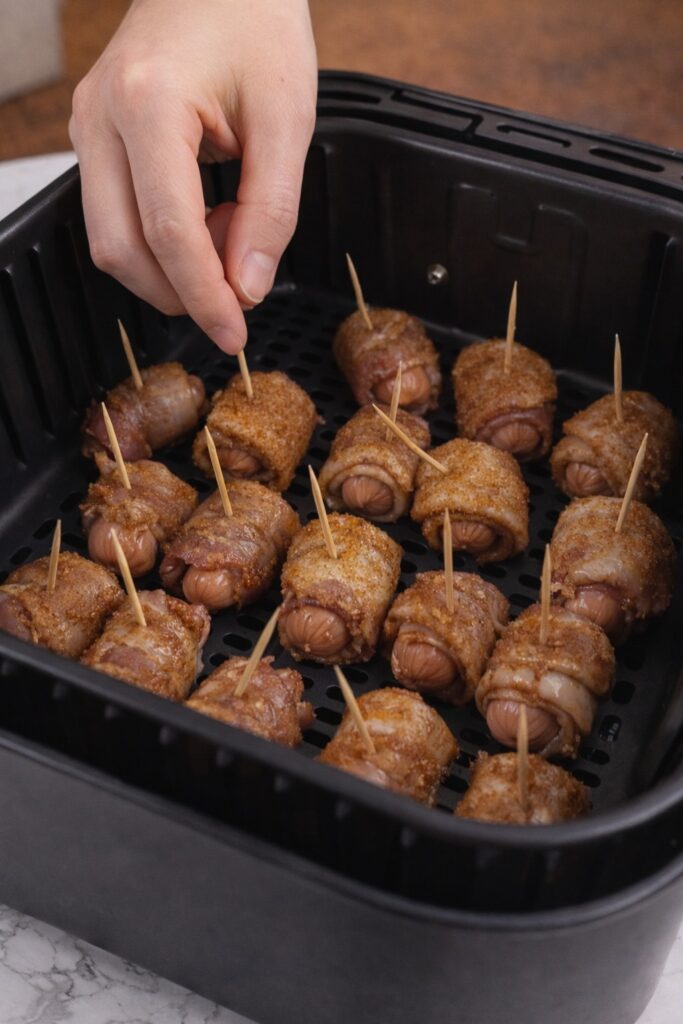
Arrange the wrapped and secured smokies in the air fryer basket in a single, uncrowded layer. The single-layer requirement is one of the most important technical stipulations in this entire recipe. An air fryer works by circulating hot air at high velocity around and beneath the food — when pieces are stacked or overcrowded, this airflow is obstructed, and the food in the overlap zones steams in the moisture produced by its neighbors rather than being exposed to the dry, circulating hot air that produces crisping. Overcrowded smokies produce rubbery, pale, poorly crisped bacon rather than the deeply caramelized, brittle-glazed result this recipe targets. Work in batches if necessary — the second batch will be ready in 12 minutes and your guests will be perfectly happy waiting for it.
Step 5 — Cook at 350°F for 12 Minutes
Set the air fryer temperature to exactly 350°F (175°C) and the timer to 12 minutes. This specific temperature is the result of a carefully considered balance between two competing requirements: the bacon needs heat high enough to render its fat and develop Maillard reaction browning, but the brown sugar needs to stay below the scorching threshold. Brown sugar’s sucrose content begins caramelizing at approximately 320°F and starts to burn and develop unpleasant bitter, acrid notes above approximately 375°F. At 350°F, the bacon renders and crisps at a rate that keeps pace with the sugar’s caramelization — they arrive at their respective ideal states at approximately the same moment, producing that perfect combination of crispy, rendered bacon with a deep, dark, glossy caramel exterior that makes this recipe so legendary.
Step 6 — Check at the 10-Minute Mark
At the 10-minute mark, pause the air fryer and briefly inspect the smokies. You are looking for bacon that has turned a deep mahogany brown and has developed a visibly stiff, non-pliable texture when gently tested with tongs — this stiffness indicates that the fat has rendered sufficiently and the bacon is approaching the crispy finish you want. You are also watching the brown sugar — it should have melted, bubbled, and begun darkening into an amber-colored glaze. If the sugar appears very dark or smells burned rather than caramelized, reduce the temperature to 325°F and finish the remaining time at the lower setting. Every air fryer runs slightly differently, and this check-in at 10 minutes provides the opportunity to course-correct before the dish is compromised.
Step 7 — Rest and Serve
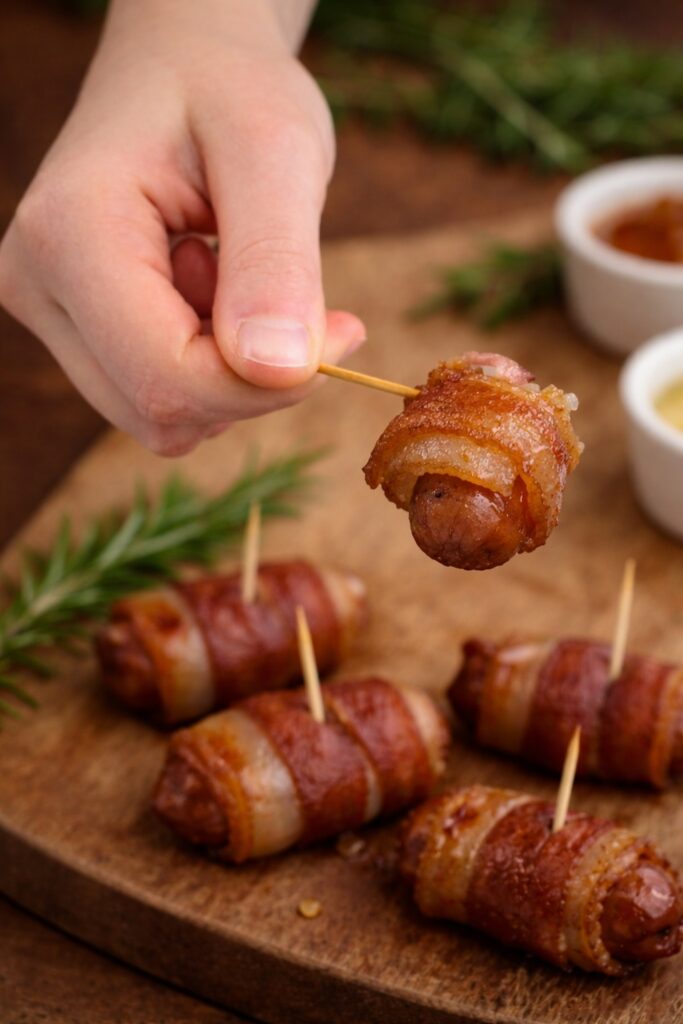
When the smokies emerge from the air fryer, the brown sugar glaze will be in a molten, liquid state — hot, fluid, and dangerously sticky. Do not attempt to serve them immediately. Allow them to rest on a heat-safe plate or wire rack for 2 to 3 minutes. During this brief rest period, the molten sugar cools and solidifies into a hard, brittle, candy-like crust that adheres tightly to the crispy bacon surface — the textural transformation from liquid glaze to crunchy shell happens entirely during this rest, and it is what creates the satisfying crack and crunch of the finished product. Transfer to a warm serving platter and serve immediately while the glaze is at its peak consistency. Have napkins available in generous quantity.
Air Fryer Bacon-Wrapped Smokies
Sweet brown-sugar glazed bacon-wrapped cocktail sausages — crisp, sticky, and party-perfect
- 1 package cocktail smokies (12–14 oz)
- 1 lb standard-cut bacon (not thick-cut)
- ⅔ cup brown sugar (light or dark)
- ¼ tsp cayenne pepper or chili powder (sweet & spicy)
- Toothpicks
- Air fryer
Cut the Bacon
Cut each bacon strip in half crosswise. (Half-strips wrap 1–1½ turns for even crisping.)
Coat in Brown Sugar
Press each bacon half-strip into brown sugar on both sides. (Mix cayenne/chili into sugar if using.)
Wrap & Secure
Wrap one smoky with one sugar-coated bacon half-strip and secure through bacon + sausage with a toothpick.
Load the Air Fryer
Arrange in a single, uncrowded layer in the basket. Cook in batches if needed for best crisping.
Air Fry
Cook at 350°F (175°C) for 12 minutes.
Check at 10 Minutes
Look for deep mahogany bacon and bubbling amber glaze. If sugar is getting too dark, finish at 325°F.
Rest & Serve
Rest 2–3 minutes so the glaze hardens into a crunchy shell. Serve warm with plenty of napkins.
Conclusion: Simplicity as the Ultimate Party Strategy
The Air Fryer Brown Sugar Bacon Wrapped Smokies recipe is proof of a principle that experienced home cooks and professional chefs alike have understood for generations: at its best, food does not need complexity to be extraordinary. It needs balance. Three ingredients — sausage, bacon, brown sugar — each chosen because it contributes something the others cannot, each performing a specific role in the finished product that is irreplaceable. The cocktail smoky provides the savory, meaty, pre-seasoned interior that makes the bite satisfying at its core. The bacon provides the fat vehicle that renders during cooking and bastes the sausage from the outside in, keeping it impossibly juicy while simultaneously creating the crispy, chewy, smoky textural wrapper that makes the exterior interesting. And the brown sugar provides the sweet, caramelized, candy-brittle glaze that ties every element together and creates the flavor contrast — sweet against salt, crispy against tender, caramel against smoke — that makes these impossible to eat just one of.
The air fryer’s contribution to this recipe is not merely about speed, though the 12-minute cook time versus the oven’s 45 minutes is a meaningful advantage for any party host juggling multiple preparations simultaneously. The air fryer produces a fundamentally better result than the oven method by virtue of its cooking mechanism: the circulating hot air reaches the bacon from all sides rather than only from below, producing more even fat rendering and more complete sugar caramelization across every surface of every smoky in the basket. The excess fat drips away from the meat rather than pooling beneath it in a sticky, smoking mess. The cleanup, if an air fryer-safe parchment liner is used, is a matter of minutes rather than the extended soaking session that a sugar-coated baking sheet demands.
At approximately 280 calories per serving, these smokies are admittedly a treat rather than a nutritional cornerstone — and they make no pretense otherwise. They are high in fat, substantial in sugar, and deeply, unapologetically satisfying in the way that only the most honest of party foods can be. Make them the next time you are asked to bring something to share, and watch what happens when you set them down on the table. The platter will be empty before you have had time to find a napkin for yourself.
FAQs about Brown Sugar Bacon-Wrapped Smokies
What is the chemical difference between light and dark brown sugar and how does it specifically affect this recipe?
Both light and dark brown sugar are refined white cane sugar (sucrose) with molasses added back during processing. Light brown sugar contains approximately 3.5% molasses by weight; dark brown sugar contains approximately 6.5%. The additional molasses in dark brown sugar contributes three differences in this recipe: a deeper, more complex caramel flavor with bitter-edge notes from the molasses’s organic acids; a darker final color in the glaze (deeper mahogany versus amber); and slightly more moisture from the molasses, which increases the sugar’s adhesion to the raw bacon surface during the pressing step. Neither is objectively “better” — light produces a cleaner, sweeter glaze; dark produces a more complex, deeper-flavored one.
Why does thick-cut bacon specifically fail in this recipe while standard-cut succeeds?
Standard-cut bacon (approximately 1/16 inch thick) renders its intramuscular fat within the 12-minute cook window — the fat melts, migrates to the bacon surface, and evaporates along with the bacon’s moisture, leaving a crisp, dry protein structure behind. Thick-cut bacon (approximately ¼ inch) has three to four times more fat and moisture to render, requiring substantially more time (20–25 minutes) to achieve the same rendered-fat state. In the time it takes thick-cut bacon to approach crispness, the brown sugar coating has passed through its caramelization window, scorched, and developed bitter, acrid flavor compounds — while the cocktail smoky has overheated and shriveled. Standard-cut bacon’s thinner profile keeps all three processes (rendering, crisping, caramelization) synchronized.
What is the specific role of molasses in brown sugar as an adhesive for the bacon surface during the pressing step?
Molasses is a viscous, high-sugar, slightly acidic syrup — at room temperature, its viscosity is high enough (approximately 5,000–10,000 centipoise) to create significant surface tension when pressed against the protein and fat surface of raw bacon. When brown sugar granules are pressed firmly against the slightly cold, slightly moist, slightly fatty surface of raw bacon, the molasses coating on each sugar crystal acts as a natural contact adhesive, creating mechanical and chemical bonding between the sugar crystal and the bacon surface through a combination of surface tension and the mild tackiness of the molasses proteins. This adhesion is strong enough to survive the wrapping and toothpick-securing process without the sugar granules falling off.
What is the precise burn temperature of the sucrose component of brown sugar and how does 350°F maintain safe operation?
Sucrose begins to char and produce acrolein and furfural — the primary compounds responsible for the acrid, bitter flavor of burnt caramel — at approximately 375–380°F (190–193°C). At 350°F (175°C), the air fryer’s internal temperature is operating at a margin of 25–30°F below this threshold — sufficient to drive vigorous caramelization without triggering the degradation reactions that produce bitterness. The actual temperature experienced at the sugar-bacon interface may be slightly higher than the air fryer’s set temperature due to the additional heat generated by the bacon fat rendering, which is why monitoring at the 10-minute mark is a critical safety check rather than a cosmetic suggestion.
Can erythritol-based brown sugar substitutes genuinely replicate the caramelization behavior of sucrose-based brown sugar?
Erythritol (a sugar alcohol) does not undergo the same caramelization chemistry as sucrose because it lacks the reactive aldehyde and ketone groups that allow sucrose’s hydrolysis products (glucose and fructose) to participate in the caramelization cascade. Commercial brown sugar substitutes that use erythritol combined with monk fruit or allulose produce browning through slightly different chemical pathways — allulose in particular has a Maillard-like browning behavior at elevated temperatures. The result will be visually similar to a sucrose-based glaze, but the flavor compounds produced are different — the characteristic deep, complex caramel flavor of sucrose caramelization is not fully replicable by any current commercial substitute, though the result is entirely acceptable for those following low-glycemic or ketogenic dietary patterns.
What is the functional difference between using a toothpick versus a cocktail skewer for securing the bacon wrap?
Standard toothpicks (approximately 2.5 inches long, 1.5–2mm diameter) provide sufficient penetration depth to pass through both the top bacon layer and the cocktail smoky and emerge through the opposite bacon layer — locking all three elements (top bacon, smoky, bottom bacon) into a fixed relationship that survives the contracting forces of the cooking bacon. Cocktail skewers (longer, typically 3.5–4 inches) provide more mechanical leverage but introduce the risk of protruding ends catching on the air fryer basket during the cook, potentially displacing smokies from their arranged position. Standard toothpicks are the correct choice for air fryer preparation specifically; cocktail skewers are more appropriate for oven-baked versions where positional disturbance is less likely.
What is the glycemic index impact of the brown sugar glaze per serving and how does it interact with the high fat content of the bacon?
The brown sugar used in this recipe (⅔ cup, approximately 133g) distributes across approximately 25–30 wrapped smokies, meaning each smoky receives approximately 4–5g of sugar — or approximately 16–20g of sugar per 4–5 smoky serving. Brown sugar’s glycemic index is approximately 64 (medium). However, the high fat content of the bacon and the sausage in each serving significantly slows gastric emptying and thereby attenuates the rate of glucose absorption from the sugar — a well-documented fat-carbohydrate interaction that effectively lowers the glycemic response below what the sugar’s GI alone would predict. This does not make these smokies “healthy,” but it does mean the sugar spike is considerably blunted by the surrounding fat content.
What is the food science explanation for why these reheat successfully in an air fryer at 320°F while many sugar-glazed foods do not?
The brown sugar glaze, once fully caramelized and cooled to a hard crystalline state, has a relatively stable structure that can be brought back through its melting transition without burning if the reheating temperature is kept below 340°F. At 320°F in a brief 2–3 minute reheat, the crystallized sugar has sufficient time to soften slightly and become tacky again (partially re-entering its amorphous liquid state) while the bacon recrystallizes its rendered fat and re-establishes its crispy structure. The key variable is brevity — a 2–3 minute reheat is enough to restore texture without driving the sugar through its caramelization window again. Oven reheating at the same temperature would produce comparable results but requires significantly longer preheat time.
What is the maximum safe storage duration for pre-assembled uncooked smokies and what happens to the sugar coating during refrigeration?
Pre-assembled, uncooked bacon-wrapped smokies can be safely refrigerated for up to 24 hours at 40°F (4°C) or below. During this refrigeration period, the brown sugar coating partially absorbs moisture from the bacon’s surface through osmosis and from the humidity within the refrigerator, causing the sugar granules to partially dissolve into a slightly sticky, wet layer rather than maintaining their dry granule texture. This moisture uptake does not significantly compromise the final result — the sugar still caramelizes correctly during cooking — but it does make the pre-assembled smokies slightly more difficult to handle cleanly when loading the air fryer. Using a slightly higher sugar quantity (a generous ¾ cup instead of ⅔ cup) when making ahead compensates for this partial dissolution.
Why is smoked paprika a specifically effective optional addition to the brown sugar rather than regular paprika?
Smoked paprika (pimentón ahumado) is produced by drying and grinding red peppers that have been cold-smoked over oak wood fires — typically for several weeks in traditional Spanish production. The smoking process introduces the same phenolic compounds (guaiacol, syringol) described in the applewood bacon analysis, which in this context add a woodsmoke depth that resonates with the smokies’ own pre-smoking character. Regular sweet paprika lacks these smoke phenolics, contributing only carotenoid color and mild sweet pepper flavor. The specific pairing of smoked paprika with brown sugar caramelization produces a flavor complex that evokes the best qualities of classic American barbecue — sweet, smoky, slightly spicy — in a concentrate that enhances rather than complicates the recipe’s simple three-ingredient purity.
Explore our extensive collection of culinary delights that range from quick weeknight dinners to impressive entertaining dishes. Start your morning right with our five essential egg breakfast ideas, or try our chili crisp egg avocado toast for a modern twist. For those seeking healthier morning options, discover our healthy oatmeal apple banana cake, coconut cove baked oatmeal, and blueberry apple morning oats cake. Vegetarian breakfast enthusiasts will love our protein powder cinnamon rolls. For lunch, enjoy classics like the ultimate big mac salad, crispy potato tacos, quick ham and cheese pinwheels, and vegan bulgogi pinwheels. Our main course selection includes impressive options such as Vietnamese lemongrass chicken, honey balsamic pomegranate glazed chicken, mushroom stuffed chicken breast, and baked French onion chicken. Meat lovers should try our three Italian style meatloaves, pan seared pork tenderloin in creamy peppercorn gravy, and citrus glazed roasted pork ribs with creamy mushroom potatoes. For pasta and seafood, explore shrimp aglio e olio, New England creamy clam chowder, Manhattan clam chowder soup, red pesto gnocchi, brown butter and sage mezzi rigatoni, and creamy peri peri chicken pasta. Our soup collection features creamy broccoli and garlic soup, carnival squash soup with turmeric, split pea soup, ham bean soup, hearty vegetable barley soup, and creamy asparagus soup. Vegetarian options include vegan ramen, quick vegan lasagna, vegan cabbage rolls, spicy maple tofu rice bowl, and vegan chicken and dumpling soup. For sides, enjoy garlic butter cheese bombs, oven baked potatoes with meatballs and cheese, broccoli recipes that taste amazing, oven roasted crispy potato, honey butter cornbread, and one pan Tuscan orzo with chicken. Our appetizer selection includes the ultimate crispy buffalo chicken wonton cups, the ultimate buffalo chicken cauliflower dip, the ultimate buffalo chicken garlic bread, and garlic parmesan wings. Desserts range from blueberry tiramisu and heavenly molten mini chocolate lava cakes to thin and chewy chocolate chip cookies. For special occasions, try red velvet cookies, Valentine heart cookies, ombre heart buttercream cake, and homemade Valentine’s day mini cake delight. Keto dieters will appreciate our keto schnitzel, sugar free keto German chocolate cake, keto yogurt almond cake, keto beef roulades, fluffy keto cloud bread, keto muffins, Korean marinated eggs, and low carb cottage cheese ice cream. Additional healthy options include sugar free oat cakes, sugar free banana oat brownies, and low carb Tuscan chicken bake. For beverage enthusiasts, enjoy our cocktail collection including classic whiskey sour, hot apple whisky lime cocktail, easy margarita, Paloma tequila cocktail, vodka cranberry cocktail, Angel Face cocktail, Mandarin Sunrise cocktail, Aperol Spritz, homemade Piña Colada, virgin Piña Colada mocktail, Moscow Mule, Old Fashioned, Manhattan cocktail, Pomegranate Gimlet, Southside gin cocktail, Paper Plane cocktail, Mango Chilli Margarita, and our ten best rum cocktails. These carefully curated recipes offer something for every palate, occasion, and dietary preference.