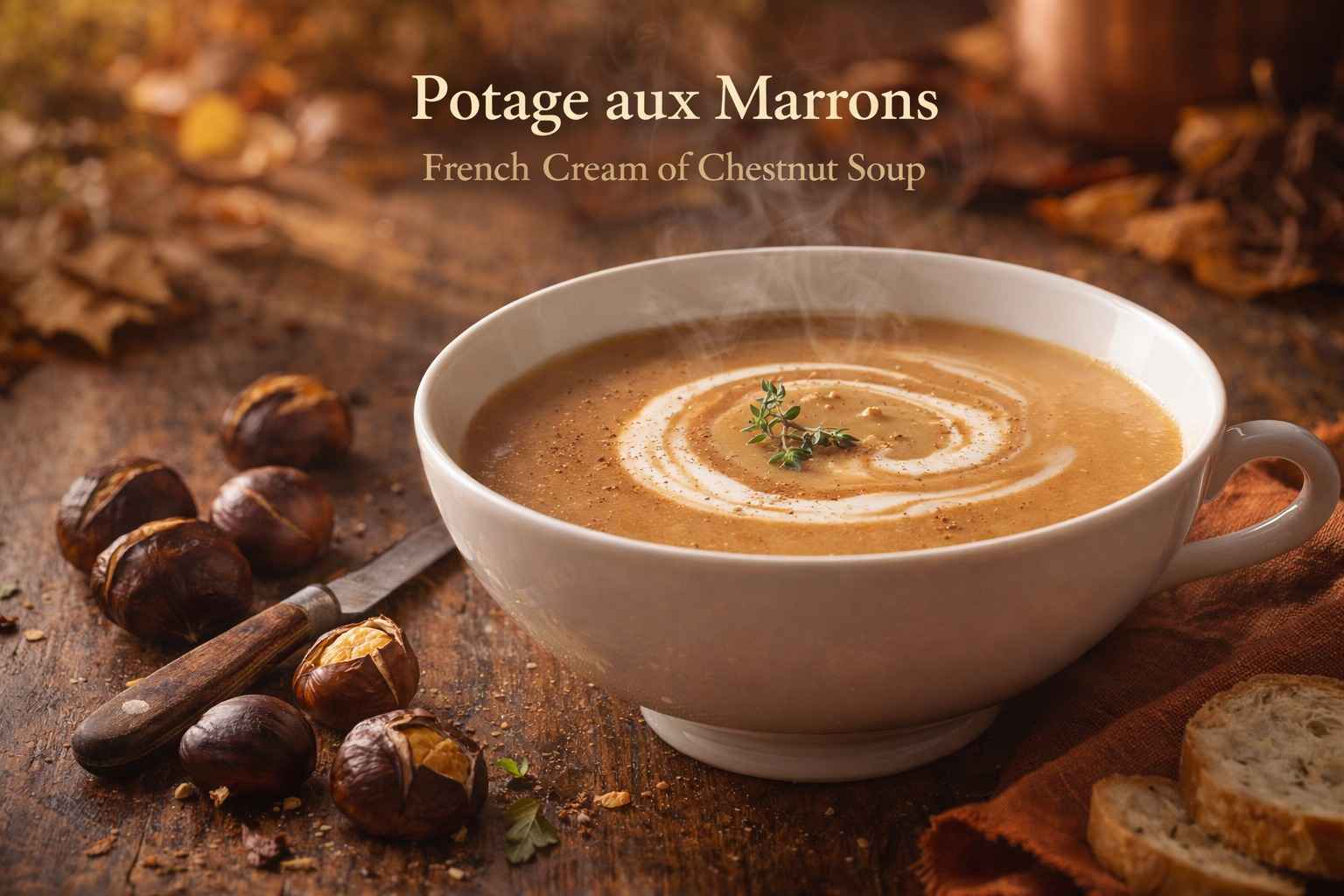
There are ingredients that belong so completely to a single season that encountering them — their scent, their texture, their particular flavor — is enough to summon that season’s entire emotional atmosphere in an instant. For autumn, that ingredient is the chestnut. The warm, sweet, earthy aroma of chestnuts roasting over an open fire is one of the most universally recognized sensory signatures of the fall season, embedded in cultural memory across Europe and beyond for centuries. But the chestnut’s culinary life extends far beyond the street corner roasting pan — and nowhere is it expressed with more sophistication, more elegance, or more deeply satisfying effect than in a perfectly made bowl of Potage aux Marrons: French Cream of Chestnut Soup.
This is not a simple recipe. It is not designed to be. The preparation of fresh chestnuts — scoring, steaming, and the patient, methodical peeling of both the hard outer shell and the bitter inner pellicle — is a ritual that demands time, attention, and a willingness to engage with an ingredient on its own terms rather than demanding convenience. But this ritual is also the source of the recipe’s most important quality: the flavor of fresh, properly prepared chestnuts is a thing of genuine culinary wonder — simultaneously starchy and sweet, earthy and delicate, rich without heaviness — and it is entirely beyond the reach of any canned or pre-packaged alternative. If you are willing to do the work, the chestnut will reward you in proportion.
What emerges from this recipe is a soup that occupies a rare position in the culinary spectrum: it is simultaneously rustic and refined, nourishing and elegant, deeply comforting and genuinely sophisticated. The natural starch of the chestnuts provides the soup with a velvety body that no artificial thickener could replicate. The sautéed onions, deglazed with a splash of Marsala wine, build an aromatic depth that supports rather than competes with the chestnut’s delicate sweetness. The herb bouquet — bay leaf, fresh thyme, whole cloves — infuses the simmering stock with a warm, woodsy complexity. And the finishing touches of heavy cream, maple syrup, and a pinch of nutmeg round every element into a harmonious whole that is, in the most precise culinary sense of the word, magnificent. Whether you are serving it as a show-stopping Thanksgiving appetizer or a quiet, autumnal weeknight supper, this is a soup worth every minute it takes to make.
Recipe Details
| Detail | Info |
|---|---|
| Cuisine | French / Italian |
| Course | Appetizer / Starter |
| Difficulty | Medium (due to chestnut preparation) |
| Servings | 4–6 People |
| Prep Time | 40 Minutes (includes peeling) |
| Cook Time | 30 Minutes |
| Calories per Serving | Approx. 320 kcal |
Ingredients
The Chestnuts:
- 1 lb fresh chestnuts (Italian variety strongly preferred)
The Aromatic Base:
- 1 medium onion, finely diced
- Butter or oil for sautéing
- A splash of Marsala wine or dry Sherry
The Liquid:
- 4 cups chicken stock (or high-quality bone broth)
- ½ to 1 cup heavy cream (adjust for desired consistency)
The Herb Bouquet (Bouquet Garni):
- 1 bay leaf
- 2 whole cloves
- A few sprigs of fresh thyme
- Kitchen twine for tying
The Seasoning & Finish:
- 1 tbsp maple syrup
- A pinch of freshly grated nutmeg
- Salt and freshly ground black pepper, to taste
Optional Garnish:
- A swirl of heavy cream
- Caramelized onions
- Sautéed mushrooms (porcini particularly recommended)
Step-by-Step Instructions
Step 1 — Score the Chestnuts
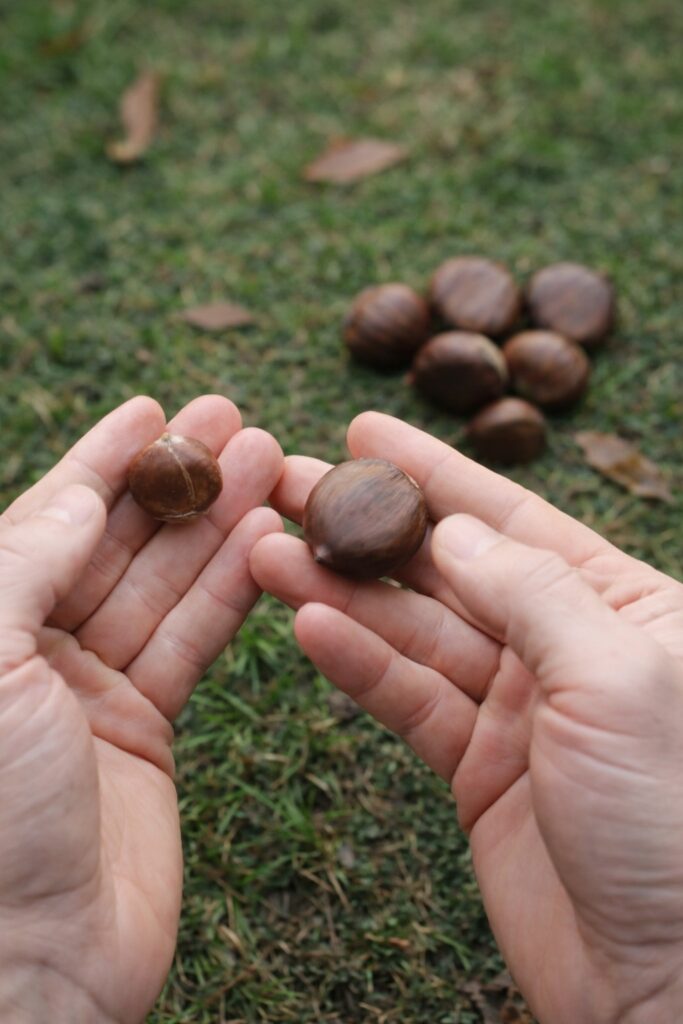
Place each chestnut flat-side down on a cutting board — never on its round side, which is unstable and can cause the nut to slip and roll, sending a sharp knife in a dangerous direction. Using a firm, sharp paring knife or a dedicated chestnut knife, score an “X” through the shell on the flat face of each nut, cutting deeply enough to penetrate both the hard outer shell and the underlying inner skin. Some cooks prefer a single long slit along the chestnut’s equator — both methods work equally well, so use whichever you find more comfortable and consistent. Every chestnut must be scored before any heat is applied: an unscored chestnut in a hot pan or pot will trap expanding steam with nowhere to escape, and can burst with surprising force and heat. This step is both a culinary and a safety requirement.
Step 2 — Steam or Boil the Chestnuts
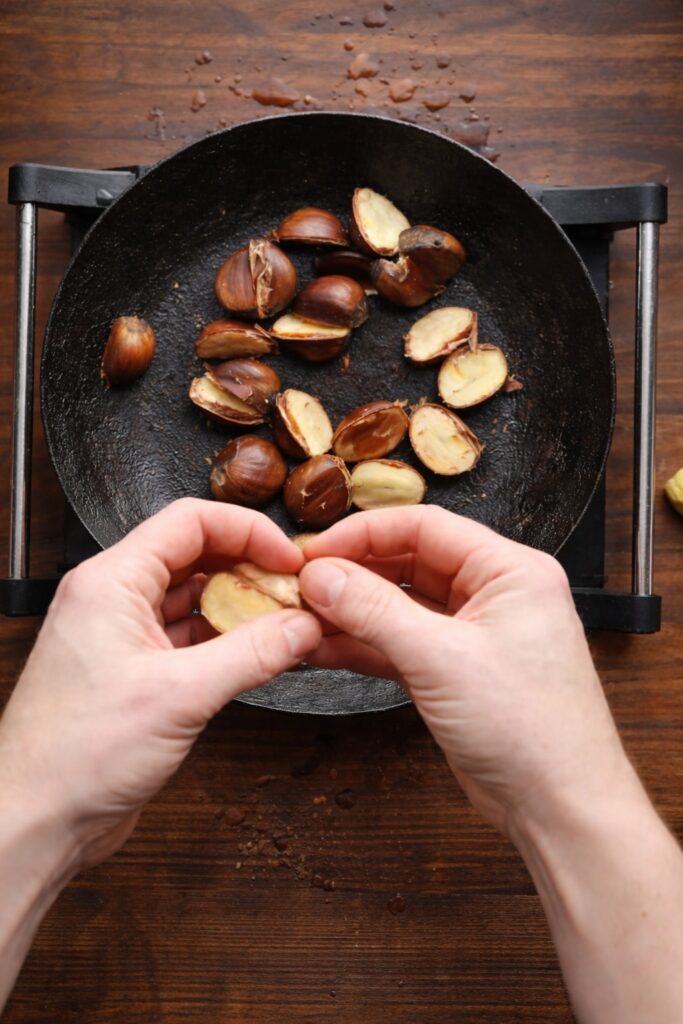
You have two reliable peeling methods at your disposal, both of which begin with the same score-and-heat principle. For the steaming method: place the scored chestnuts in a heavy skillet (cast iron or carbon steel is ideal for the high, even heat required), add a small splash of water, cover tightly, and cook over high heat for approximately 5 minutes until the scored shells visibly peel back and the nuts are soft to the touch. For the boiling method: submerge the scored chestnuts in a pot of vigorously boiling water and cook for 5 to 10 minutes until the shells have opened along the score lines and the nuts show no resistance when tested with a sharp skewer or knife tip. A useful doneness indicator is the “paperclip test” — push the tip of a straightened paperclip or a thin skewer through the shell. If it meets no resistance, the chestnut is ready to peel. For this soup, where the chestnuts will ultimately be pureed, steaming keeps them slightly moister and more flavorful than boiling — but both methods produce excellent results.
Step 3 — Peel the Chestnuts
This is the most labor-intensive and most rewarding step of the entire recipe, and it must be approached with patience and a specific technique. Work quickly, and keep the chestnuts warm throughout the peeling process — either wrapped in a clean kitchen towel to retain heat, or kept in the hot water with just a few removed at a time. The warmth is not incidental: it is essential. As chestnuts cool, the inner pellicle (the thin, papery, bitter brown skin between the outer shell and the chestnut flesh) contracts and adheres tightly to the nut surface, making it nearly impossible to remove cleanly without tearing the flesh beneath. When warm, this pellicle remains loose and pliable and peels away in large sections with minimal resistance.
For each chestnut, squeeze it gently to pop the outer shell open along its scored line, then peel away the hard shell pieces. With a dry kitchen towel, rub the remaining pellicle away from the flesh. For stubborn spots where pellicle clings to the flesh despite rubbing, use your thumbnail or the edge of a small paring knife to scrape it away. Do not be concerned if the chestnuts break into pieces during this process — they will be fully pureed in the final step, and structural integrity of individual nuts is irrelevant to the quality of the finished soup. Proceed until all nuts are peeled of both layers to the extent possible. A small remaining fragment of pellicle on any nut will not meaningfully affect the final soup’s flavor.
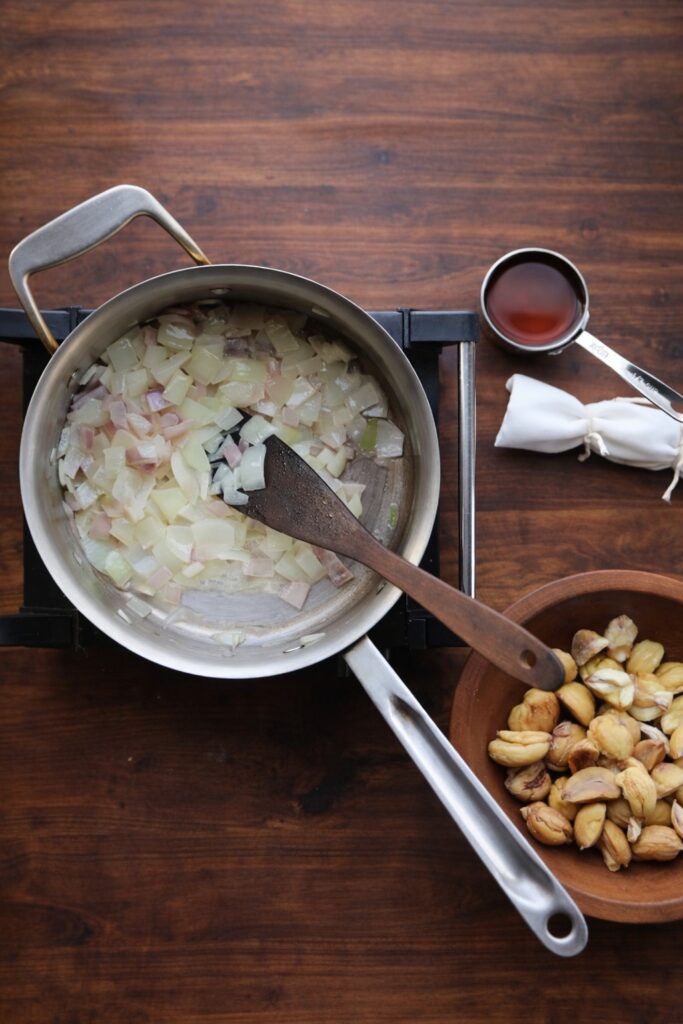
Step 4 — Sauté the Onions and Deglaze
Melt a generous knob of unsalted butter in a large, heavy-bottomed soup pot over medium-low heat. Add the finely diced onion and cook slowly and patiently, stirring occasionally, until the onion is completely translucent, deeply soft, and beginning to turn the palest gold at its edges — a process that should take a full 10 to 15 minutes when done correctly over gentle heat. The instruction here is to cook the onions “way down” — a phrase that communicates something important about the goal. An aggressively sautéed, quick-cooked onion retains a sharpness and sulfurous assertiveness that would compete directly with and ultimately overpower the chestnut’s mild, delicate sweetness. A slowly, patiently cooked onion has had time to fully convert its sharp sulfurous compounds into gentle, sweet, aromatic ones — it will support the chestnut rather than fighting it for dominance in the finished soup.
Once the onion is thoroughly softened and sweetened, increase the heat briefly and deglaze the pan with a generous splash of Marsala wine or dry Sherry. Pour the wine directly into the hot pan and use a wooden spatula to immediately scrape up and dissolve any golden-brown fond (the caramelized residue from the onion and butter) from the pan’s bottom. This fond is concentrated flavor and must be fully incorporated into the liquid — discarding it by allowing it to remain stuck to the pot would represent a significant and unnecessary loss of depth.
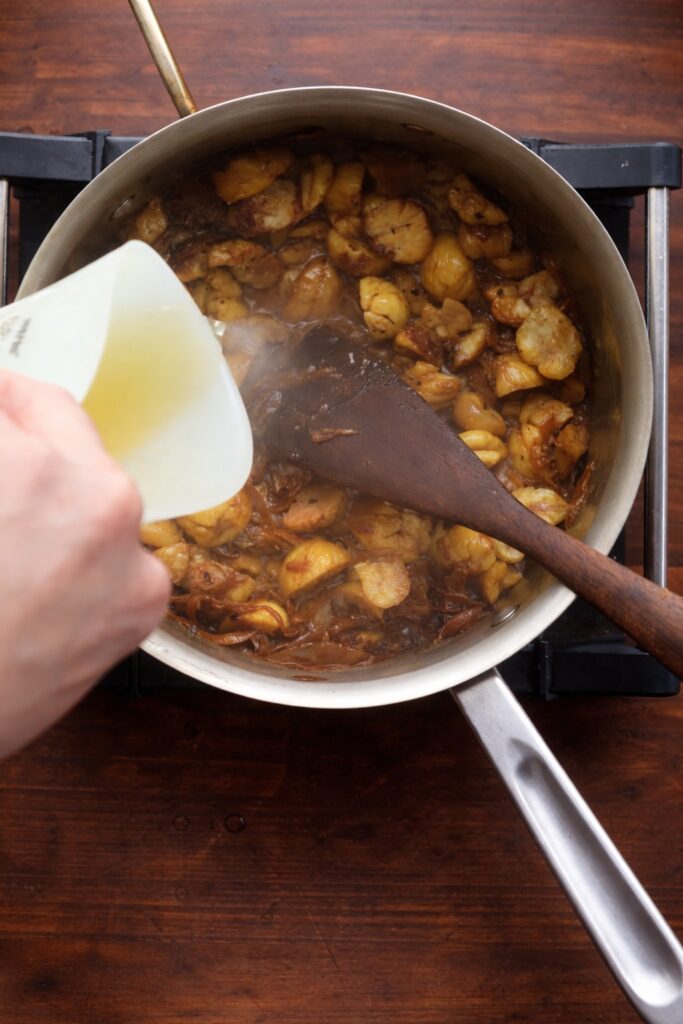
Step 5 — Simmer the Chestnuts with Stock and Herbs
Add the peeled chestnuts and all 4 cups of chicken stock (or bone broth) to the pot with the deglazed onion base. Prepare your bouquet garni by bundling the bay leaf, whole cloves, and fresh thyme sprigs together and tying them securely with kitchen twine. Lower the herb bundle into the soup, ensuring it is fully submerged in the liquid. Increase the heat to bring the pot to a gentle simmer, then reduce to maintain that simmer and cook, uncovered, for approximately 20 to 25 minutes. During this time, test the chestnuts regularly by pressing a piece firmly against the side of the pot with the back of a spoon or spatula. When the chestnut piece yields completely and mashes flat against the pot wall with almost no resistance, the nuts are fully cooked and ready for pureeing. This tactile test is more reliable than a fixed time, as individual chestnut sizes and freshness levels can vary enough to meaningfully affect cooking time.
Step 6 — Remove the Herbs and Blend
Before doing anything else, remove and discard the bouquet garni completely. This is a non-negotiable step: the bay leaf’s leathery texture, the cloves’ woody stems, and the thyme’s small woody branches must all be physically removed from the soup before blending. Failing to do so will result in these structural elements being incorporated into the puree as fibrous, unpleasantly textured fragments or, worse, as bitter broken splinters that no amount of additional blending can fully homogenize. Once the herb bundle is removed, carefully transfer the hot soup to a high-powered blender in batches, filling it no more than half full per batch and holding the lid firmly with a folded kitchen towel before starting. Blend each batch at high speed for a minimum of 60 to 90 seconds — long enough for the chestnut starch to fully emulsify with the stock and create the characteristic velvety smoothness that defines this soup. A Vitamix or comparable high-powered blender will produce the most refined result. Return all blended soup to the pot.
Step 7 — Season, Finish, and Serve
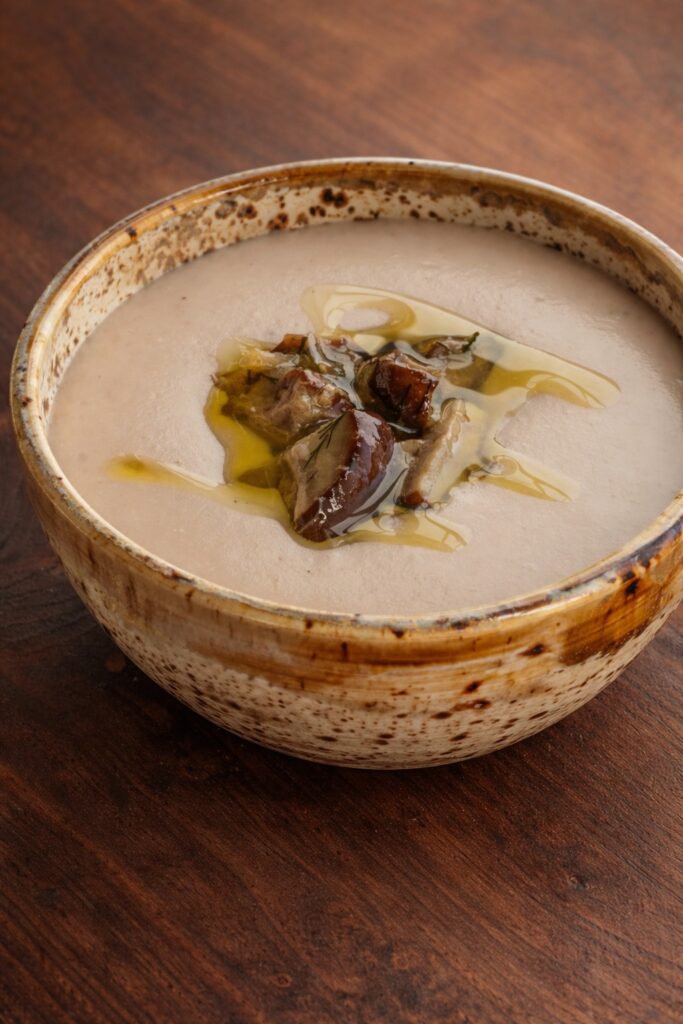
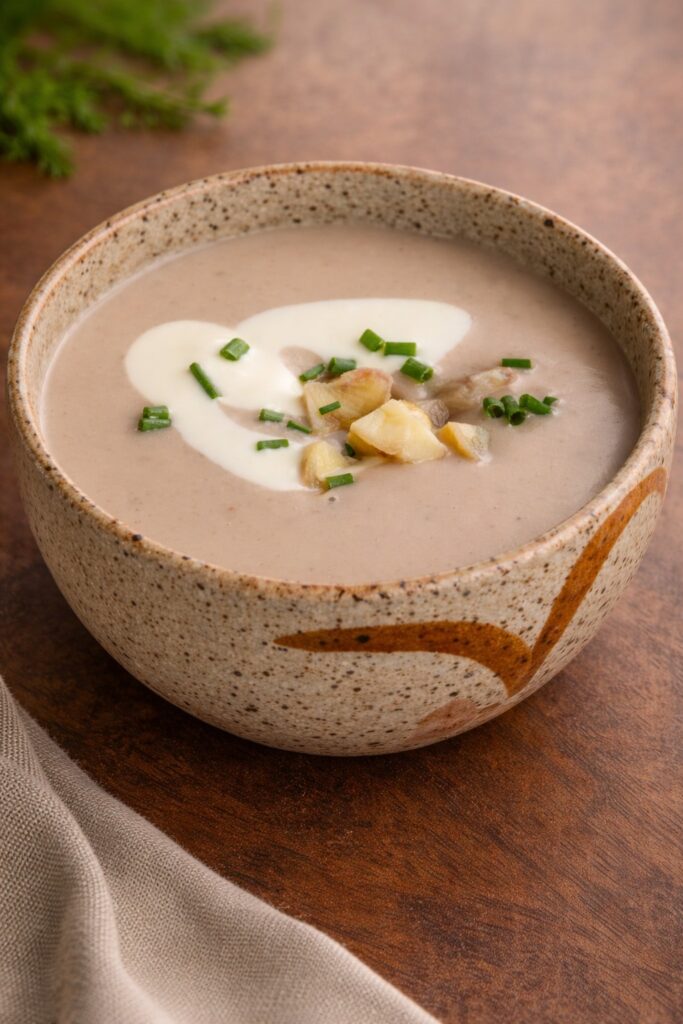
Return the smooth pureed soup to gentle heat. Stir in the heavy cream, beginning with ½ cup and increasing to up to 1 cup depending on your preferred consistency — more cream produces a thinner, silkier soup, while ½ cup maintains a thicker, more intensely chestnut-forward body. Add the tablespoon of maple syrup, which does not make the soup taste sweet in any confectionery sense, but rather enhances the chestnut’s own natural sweetness in a way that makes it seem more fully realized. Grate in a careful pinch of fresh nutmeg — this is a finishing spice, present as an accent rather than a flavor, and should register as warmth and complexity rather than as a distinct or identifiable nutmeg note. Season carefully with salt and black pepper, tasting repeatedly and adjusting in small increments. As the source material wisely notes, the difference between a good bowl of chestnut soup and a great one lives entirely in the precision of this final seasoning moment. Ladle into warmed bowls and garnish with a elegant swirl of cream, a small mound of deeply caramelized onions, or a scattering of sautéed porcini mushrooms.
Velvety Chestnut Soup
Silky chestnut purée with Marsala, thyme, and a whisper of maple + nutmeg
- 1 lb fresh chestnuts (Italian variety preferred)
- 1 medium onion, finely diced
- Butter or oil, for sautéing
- Splash of Marsala wine or dry Sherry
- 4 cups chicken stock (or quality bone broth)
- ½ to 1 cup heavy cream (to taste)
- 1 bay leaf
- 2 whole cloves
- Fresh thyme sprigs
- Kitchen twine (to tie)
- 1 tbsp maple syrup
- Pinch fresh nutmeg
- Salt + black pepper, to taste
- Swirl of cream
- Caramelized onions
- Sautéed mushrooms (porcini recommended)
Score the Chestnuts
Score an “X” through shell + inner skin on the flat side of each chestnut (safety + easier peeling).
Steam or Boil
Steam in a covered skillet with a splash of water ~5 minutes, or boil 5–10 minutes until shells open and nuts soften.
Peel While Warm
Peel shell + pellicle while nuts are warm (keep wrapped in a towel). Broken pieces are fine.
Sauté Onion + Deglaze
Sauté onion in butter/oil over medium-low 10–15 minutes until very soft. Deglaze with Marsala/Sherry and scrape up fond.
Simmer with Stock + Herbs
Add chestnuts + stock. Tie bay, cloves, thyme into a bouquet garni and simmer 20–25 minutes until chestnuts mash easily.
Remove Herbs + Blend
Remove bouquet garni. Blend in batches (60–90 seconds) until completely silky, then return to pot.
Finish & Serve
Stir in ½–1 cup cream, maple syrup, and a pinch of nutmeg. Season with salt + pepper. Garnish as desired.
Conclusion: The Patience of the Autumn Kitchen
Potage aux Marrons is a soup that teaches the patient cook something genuinely valuable: that some of the most sophisticated and deeply satisfying results in cooking come not from elaborate technique or exotic ingredients, but from the willingness to slow down, to respect the ingredient, and to give each step of the preparation the time and attention it deserves. The chestnut demands this of anyone who wishes to use it at its best. You cannot rush the scoring, cannot abbreviate the peeling, cannot hurry the onion’s slow transformation from sharp to sweet. Each of these steps has its own proper tempo, and a cook who works at the ingredient’s pace rather than against it is rewarded with a soup of extraordinary quality.
The natural starch of the fresh chestnut is the recipe’s most remarkable quality — and it is one that simply cannot be replicated by any canned alternative. When a fully cooked, fully softened fresh chestnut is pureed in a high-powered blender with warm stock, that starch dissolves and emulsifies into the liquid in a way that is functionally indistinguishable from adding cream — producing a body, a smoothness, and a coating mouthfeel that feels genuinely luxurious long before the actual cream is added. The cream, when it does arrive, provides a dairy richness and thinning effect that opens the soup’s texture into something even more refined. And the final touch of maple syrup and nutmeg is not decoration but completion — a whisper of sweetness and warmth that ties the chestnut’s earthiness to its sweetness and brings the entire bowl into perfect harmony.
Consider following the Italian tradition when garnishing this soup, as the source material suggests: porcini mushrooms grow symbiotically with chestnut trees in the forest, meaning these two ingredients share not only an ecological origin but an almost preordained flavor affinity. A few slices of gently sautéed porcini placed at the center of each bowl bring an earthy, woodsy depth that deepens the soup’s autumnal character beautifully. Store any leftovers in the refrigerator for up to 3 days — the flavor deepens noticeably overnight — but always add the cream fresh when reheating for the best texture. This is a soup to be made slowly, savored deeply, and shared generously. It is the taste of autumn at its most sophisticated.
Common FAQs on French Cream of Chestnut Soup
Why are Italian chestnuts preferred over other varieties for this recipe?
Italian chestnuts (primarily Castanea sativa) are the largest commercially available sweet chestnut variety, with an average nut weight significantly higher than the Chinese chestnut (Castanea mollissima) or American chestnut (Castanea dentata). Their greater size translates directly into a higher meat-to-shell yield per nut — more usable flesh from each nut purchased and peeled. They also tend to have a slightly more pronounced, sweeter flavor than Chinese varieties, which is critical in a soup where the chestnut is the unequivocal primary flavor and every dimension of quality matters.
What is the physical chemistry of why unscored chestnuts explode during cooking?
The hard outer shell of a chestnut is structurally rigid — it cannot expand. As the internal moisture of the nut heats to above 212°F (100°C), it converts to steam, which requires approximately 1,700 times more volume than its liquid equivalent. In an unscored chestnut, this expanding steam has no exit pathway and builds pressure rapidly against the rigid shell walls. When the internal pressure exceeds the shell’s tensile strength — which it does quickly at high heat — the shell ruptures explosively, projecting shell fragments and hot chestnut flesh with considerable force. The score provides a pressure release valve that prevents this rupture.
What specifically makes the round side of a chestnut unstable for scoring?
A chestnut’s round side (the convex outer surface) is a continuously curved surface with no flat plane at any angle. When placed on a cutting board with this side down, the nut contacts the board surface at a single point rather than along a flat area, creating what engineers call a single-point contact support — the most mechanically unstable configuration possible. Any slight lateral force from the knife during scoring causes the nut to rotate or roll away from the blade, redirecting the knife in an uncontrolled direction. The flat side, by contrast, creates a broad, stable contact surface that anchors the nut firmly against the cutting board.
What is a bouquet garni and what is the precise culinary purpose of each element in this specific version?
A bouquet garni is a bundle of aromatic herbs tied together with kitchen twine for easy removal after infusion. In this recipe, the bay leaf contributes eucalyptol and linalool — herbal background compounds that provide a woodsy, slightly medicinal depth that complements the chestnut’s earthiness. The fresh thyme provides thymol and carvacrol — warm, slightly floral, and earthy monoterpenes. The cloves contribute eugenol — a phenolic compound with a warm, distinctly spicy character that echoes the chestnut’s own natural warmth. Together, they create an autumnal herbal chord that supports and deepens the chestnut’s flavor without competing with it.
What does Marsala wine specifically contribute to the flavor profile that a neutral white wine cannot?
Marsala is a fortified Sicilian wine made from local grape varieties, fortified with grape brandy to a higher alcohol content (17–20%) and aged in oak casks. This process produces high concentrations of acetaldehyde, ester compounds, and oxidative aromatic molecules that give Marsala its characteristic nutty, slightly caramelized, dried-fruit aromatic profile. These aromatic compounds share tonal similarities with the chestnut’s own Maillard-derived flavor compounds, creating a resonant flavor pairing where the wine amplifies and echoes the nut’s natural character. A dry white wine, while functionally acceptable, lacks these specific aromatic compounds.
What is the relationship between Italian chestnuts and porcini mushrooms and why does it create a flavor affinity?
Chestnut trees (Castanea sativa) and porcini (Boletus edulis mushrooms) have a mycorrhizal relationship in the forest — the mushroom’s underground mycelium network forms a mutually beneficial symbiosis with the chestnut tree’s root system. The chestnut provides carbohydrates to the fungus through photosynthesis; the fungus provides minerals and water to the tree through its extensive underground network. Beyond this ecological partnership, both organisms develop their flavor compounds from a shared soil chemistry — the same mineral composition, the same organic matter, the same forest microbiology. This shared terroir produces flavors that are harmonically complementary rather than merely compatible.
Can this recipe be adapted for a slow cooker and what flavor differences result?
A slow cooker can produce a softened, onion-flavored sauce, but it cannot produce the Maillard reaction browning and concentrated sweetness of oven caramelization. Slow cookers operate at temperatures of 170–200°F (low) to 200–212°F (high) — below the Maillard threshold of approximately 280°F. The result is onions that are very soft and mildly sweet but pale in color, lacking the deep caramel complexity, concentrated flavor, and mahogany browning that the oven’s 400°F dry heat produces. The slow cooker version would be a braised onion chicken — a good dish, but a fundamentally different one that does not replicate the key flavor qualities of this recipe.
What is the “passive cooking” philosophy and how does this recipe exemplify it at the highest level?
Passive cooking refers to any technique that uses indirect heat application and extended time to achieve flavor development that would otherwise require continuous active intervention. The principle recognizes that many of the most desirable flavor transformations in cooking — caramelization, collagen-to-gelatin conversion, starch gelatinization, osmotic flavor exchange — occur most completely and most evenly when given time and steady, consistent heat rather than high heat and constant stirring. This recipe exemplifies passive cooking by delegating the most labor-intensive task in classic French cooking (onion caramelization) entirely to the oven for 80 unattended minutes, producing results that rival active stovetop technique.
Why does the recipe specifically recommend cutting the top off the garlic bulb rather than separating individual cloves?
Roasting the garlic as a whole, intact bulb serves two purposes. First, the papery skin that surrounds the entire bulb and each individual clove insulates the garlic flesh during roasting, preventing it from drying out and burning — the flesh steams slightly within its own protective wrapping, softening evenly to a paste-like consistency throughout. Second, the intact bulb structure makes removal from the dish at the end simple and clean (it can be lifted out with tongs without disturbing the onions), and the squeeze-from-the-base extraction method works far more efficiently and completely with an intact bulb than with individually placed loose cloves.
What does Italian seasoning’s oregano specifically contribute that the other herbs in the blend cannot?
Oregano’s primary aromatic compound — carvacrol — has a distinctly pungent, slightly medicinal, intensely herbal character that provides a savory edge that the blend’s other herbs (basil’s floral sweetness, thyme’s earthy warmth, marjoram’s gentle delicacy) do not replicate. In the context of a rich, sweet caramelized onion dish, oregano’s assertive herbal edge provides a counterpoint that prevents the overall flavor from becoming cloying or one-dimensionally sweet. It is the most “savory” herb in the blend, and its presence is what gives the Italian seasoning mixture its characteristic bold, recognizable aromatic quality.
Explore our extensive collection of culinary delights that range from quick weeknight dinners to impressive entertaining dishes. Start your morning right with our five essential egg breakfast ideas, or try our chili crisp egg avocado toast for a modern twist. For those seeking healthier morning options, discover our healthy oatmeal apple banana cake, coconut cove baked oatmeal, and blueberry apple morning oats cake. Vegetarian breakfast enthusiasts will love our protein powder cinnamon rolls. For lunch, enjoy classics like the ultimate big mac salad, crispy potato tacos, quick ham and cheese pinwheels, and vegan bulgogi pinwheels. Our main course selection includes impressive options such as Vietnamese lemongrass chicken, honey balsamic pomegranate glazed chicken, mushroom stuffed chicken breast, and baked French onion chicken. Meat lovers should try our three Italian style meatloaves, pan seared pork tenderloin in creamy peppercorn gravy, and citrus glazed roasted pork ribs with creamy mushroom potatoes. For pasta and seafood, explore shrimp aglio e olio, New England creamy clam chowder, Manhattan clam chowder soup, red pesto gnocchi, brown butter and sage mezzi rigatoni, and creamy peri peri chicken pasta. Our soup collection features creamy broccoli and garlic soup, carnival squash soup with turmeric, split pea soup, ham bean soup, hearty vegetable barley soup, and creamy asparagus soup. Vegetarian options include vegan ramen, quick vegan lasagna, vegan cabbage rolls, spicy maple tofu rice bowl, and vegan chicken and dumpling soup. For sides, enjoy garlic butter cheese bombs, oven baked potatoes with meatballs and cheese, broccoli recipes that taste amazing, oven roasted crispy potato, honey butter cornbread, and one pan Tuscan orzo with chicken. Our appetizer selection includes the ultimate crispy buffalo chicken wonton cups, the ultimate buffalo chicken cauliflower dip, the ultimate buffalo chicken garlic bread, and garlic parmesan wings. Desserts range from blueberry tiramisu and heavenly molten mini chocolate lava cakes to thin and chewy chocolate chip cookies. For special occasions, try red velvet cookies, Valentine heart cookies, ombre heart buttercream cake, and homemade Valentine’s day mini cake delight. Keto dieters will appreciate our keto schnitzel, sugar free keto German chocolate cake, keto yogurt almond cake, keto beef roulades, fluffy keto cloud bread, keto muffins, Korean marinated eggs, and low carb cottage cheese ice cream. Additional healthy options include sugar free oat cakes, sugar free banana oat brownies, and low carb Tuscan chicken bake. For beverage enthusiasts, enjoy our cocktail collection including classic whiskey sour, hot apple whisky lime cocktail, easy margarita, Paloma tequila cocktail, vodka cranberry cocktail, Angel Face cocktail, Mandarin Sunrise cocktail, Aperol Spritz, homemade Piña Colada, virgin Piña Colada mocktail, Moscow Mule, Old Fashioned, Manhattan cocktail, Pomegranate Gimlet, Southside gin cocktail, Paper Plane cocktail, Mango Chilli Margarita, and our ten best rum cocktails. These carefully curated recipes offer something for every palate, occasion, and dietary preference.